



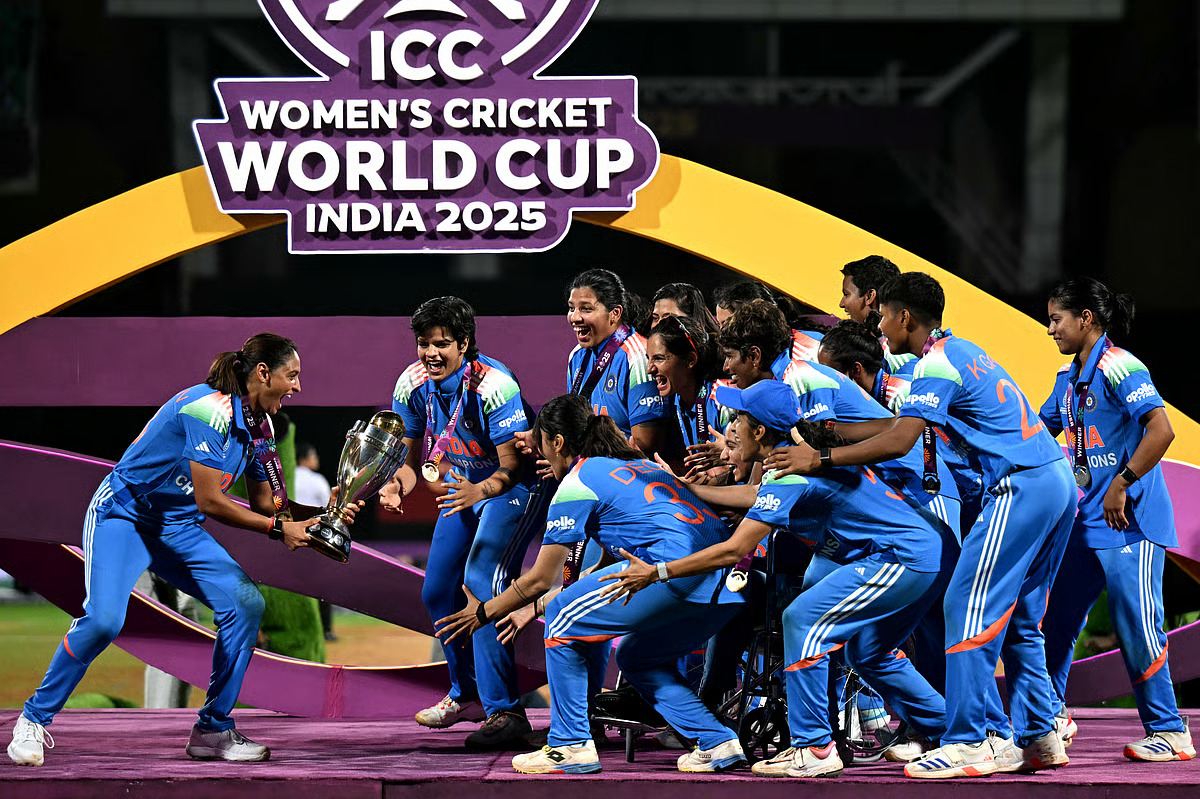
India women cricketers hail new era but challenges remain. India Women World Cup triumph has created a buzz it is hoped will enthuse a new generation and attract fresh followers to the game.
Prime Minister Narendra Modi, who is expected to host the champions on Wednesday, tweeted the “historic win will motivate future champions to take up sports”.
India beat South Africa by 52 runs on Sunday to win their first Women’s World Cup, on home soil.
At the highest level, the call for gender equality has long been led by former Board of Control for Cricket in India (BCCI) secretary Jay Shah, who introduced equal match fees for men and women.
The 50-over World Cup also had a record prize purse of $13.88 million, beating the total for the men’s event two years ago. Shah, now International Cricket Council (ICC) chairman, congratulated the team, crediting the BCCI’s “increased investment, pay parity with male cricketers (and) overhaul of the coaching staff”.
Former India captain Mithali Raj said the victory was the result of many years of work.
“For every person standing behind a young girl who dares to dream of wearing India’s colours, this is a pivotal moment, a reminder that dreams do come true,” she wrote, along with a picture of her holding the trophy
‘Women’s fast-growing influence’
Women’s sports have a long way to go to catch up in India, even after the historic World Cup win, and change may be slow. “The gender divide is most acute in adolescence and early adulthood,” a 2024 State of Sports and Physical Activity report, published with the support of international consultancy firm Dalberg, said.
“The largest gender gaps, unsurprisingly, take place when caregiving duties rise, such as in household chores and caring for children or the elderly,” the report added.
Working with the ICC, the UN children’s agency attempted to “use the World Cup as a springboard to create equal opportunities for every girl and boy,” Unicef representative to India Cynthia McCaffrey said.
“As a cricketer, I know the power the sport can have as a great equaliser,” said India vice-captain Smriti Mandhana, one of several cricketers who have signed on to the Unicef campaign.
Women represent more than a third of India’s estimated 655 million sports fans.
Women, with 236 million fans or 36 per cent, are leading the transformation of the sports market, dispelling the myth that fandom is exclusively male, according to a 2024 Deloitte and Google study
India’s Women’s Premier League (WPL), which debuted in 2023, has already generated around $700 million for the BCCI from franchise and media rights alone.
‘Girls are not fragile’
Young women cricketers say World Cup success will strengthen their sport
At a net session in a New Delhi cricket academy, a bouncer bounced into Armeet Kaur’s helmet, setting off a cascade of worried apologies.
The 20-year-old waved the bowler off and told them to continue. She stepped out of her crease at the next ball and lofted it over cleanly.
“Girls are not fragile,” she said. “And the good thing is that people know that now – after seeing women’s cricket on TV. That matters because what people think does have a bearing on the world.”
Kaur credited systemic changes in the women’s game for India’s success.
“Now the money is almost at par with men’s cricket, and there are more tournaments for women at all levels,” she said. “The good thing is that people no longer discourage girls from playing.”
The World Cup has drawn record viewers: the first 13 matches had more than 60 million viewers, five times the 2022 edition.
While modest for the world’s most populous nation, it signals growing interest in women’s cricket.
It means that Indian girls can see cricket as a viable career.
“I started playing because it was my passion,” said Ishita Singh. “But now I want it to be my full-time profession.”
Singh, 20, said she could confidently claim to be speaking on behalf of many of her peers.
“There were only two of us in the academy when I started playing some eight years ago,” she said. “Now there are so many.”
But Singh said she wished there were even more.
“Not enough girls play in India still,” she said.
“And I want that to change.”